Pros and Cons of Owning a British Shorthair: A Real One-Year Raising Guide
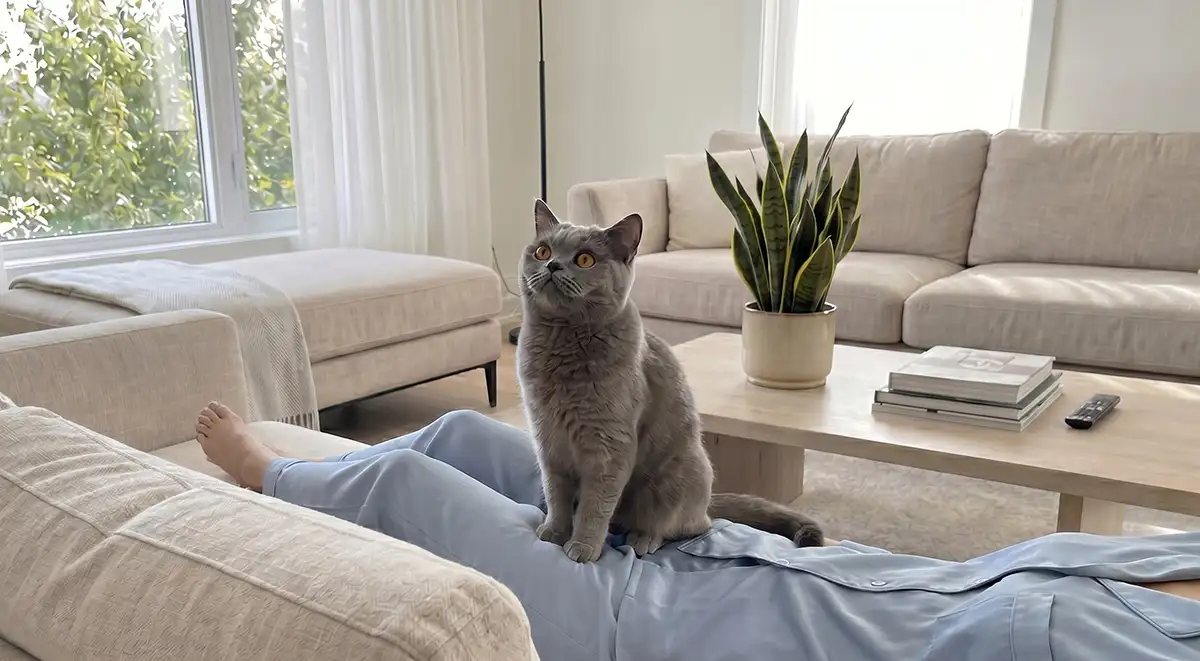
I work as a freelance journalist. Most of my days are spent brainstorming story ideas and typing away at my desk.
I still vividly remember the day I met Bella. This guide looks back at a year of our life together in the UK, before we returned to China in 2026.
I was sitting in the waiting room of an RSPCA shelter. There, I laid eyes on a British Shorthair kitten who was about six months old. She was huddled in the corner of a travel crate. Small. Utterly timid.
I cannot confirm her vaccination schedule without her records. Her round blue-grey face held the pure innocence of a young kitten. She lifted her head slowly, glancing at me with caution.
I knew right away I wanted to take her home. After the adoption process, I brought her back to my flat in London.
The memories here are from our early life together, rather than a dated daily record.
I started out as a total novice cat owner. I even had to Google basic things — like where to place a litter box and how to set it up properly.
I have become more familiar with Bella’s habits, though I cannot read every change in her mood or health.
This is what one year with Bella taught me about choosing a British Shorthair: the quiet company I value, the care I underestimated, and the questions I still need to ask. Another cat may be very different.
1. Don’t Believe the “Cold and Independent” Hype
Before adopting Bella, I had read tons of online comments claiming British Shorthairs are aloof and hard to bond with.
As someone who often pulls late nights to finish writing assignments, I specifically chose this breed for one key reason. I thought they wouldn’t demand constant attention and daily playtime.
A full year of living with Bella has completely changed my perception.
Bella’s quieter moments helped me see that keeping a little distance did not necessarily mean she wanted no company. That is my experience of her, not a promise about the breed.
There are times when I am drafting articles and Bella settles quietly nearby. There are also interruptions; she is a cat with her own needs, not a guaranteed quiet colleague.
She simply curls up on an old sweater beside my desk and naps peacefully in the sunlight filtering through my London apartment window.
When I pause to stretch, Bella sometimes blinks and nuzzles the back of my hand. At other times, she wants space. That contrast matters more to me than a breed label. I wrote more about her quieter ways of keeping me company in this diary entry.
What I Noticed When I Was Away
I used to be extremely worried about separation anxiety. I feared my six-month-old kitten would feel stressed and lonely when I left home alone.
A calm greeting when I returned could not tell me how she had felt throughout my absence.
I remember a three-day work trip to Scotland when I left food, water and clean litter trays and arranged a neighbour’s daily visit. I should not present that frequency as an adequate care plan. Cats Protection recommends at least twice-daily visits while an owner is away; kittens, older cats and cats with health needs may need more frequent care. Food supplies, cameras and automatic feeders cannot replace those visits.
When I returned, I found no scratched furniture or urine outside the tray, and she was sitting quietly by the door. Those observations did not rule out stress while I was away.
The second I stepped into the flat, she stood up slowly, wagged her tail gently and rubbed her body against my ankles.
What the quiet moments did not tell me
I treasure Bella’s company, but a quiet return after a trip could not tell me whether she had felt lonely or stressed. Her calm moments also do not remove the need for daily play, attention and reliable care when I travel.
2. Health Questions I Learned to Ask
Heart health, kidney health and body condition became questions I wanted to understand. Each needs an individual assessment; weight management is influenced by more than genetics.
I do not have records to confirm the number of Bella’s checkups or the scan results I remember. These are questions for her vet, not a verified medical history.
Risk 1: Hypertrophic Cardiomyopathy (HCM)
Cornell explains that HCM thickens the heart muscle and is more prevalent in some breeds, including British Shorthairs. Some affected cats show no obvious illness. A vet uses echocardiography and other assessment to establish the diagnosis.
I cannot confirm whether or when Bella had cardiac screening, or what an ultrasound showed, so I cannot offer her as an example of a clear result.
If your vet recommends counting sleeping breaths, ask what changes or readings should prompt a call for your cat. One count is not a diagnosis. Laboured or open-mouth breathing, collapse or sudden severe weakness needs urgent veterinary help; do not wait to reach a particular number. Cats Protection lists emergency signs.
Risk 2: Polycystic Kidney Disease (PKD)
I also worried about polycystic kidney disease. I cannot confirm Bella’s kidney scan result or the lifelong six-monthly testing schedule I recalled. I would ask her vet which screening or follow-up, if any, is appropriate to her own history rather than treat a breed label as a diagnosis.
I tried a circulating fountain as one way to offer water, but cannot pin down when she used it. Her preference did not establish her total intake or a kidney benefit. My water diary describes what I noticed without treating the fountain as a preventive treatment.
Risk 3: Weight Management
Weight management has been one of my concerns with Bella. I cannot substantiate the comparison with other kittens at adoption; her starting weight and the dates of later measurements need checking.
She has an extremely sensitive sense of smell and an insatiable craving for food. Once, I opened a bag of cat treats in the kitchen, three rooms away from where she was napping. She sprinted over in seconds and stared up at me nonstop, begging for a bite.
Excess weight can increase health risks, but neither a breed label nor kittenhood overfeeding determines a cat’s lifelong outcome. Cornell recommends an individual weight and feeding assessment; a growing kitten should not be put on an adult weight-loss plan from a blog.
I began paying closer attention to portions and treats. The treat-bag moment told me how persistent Bella could be, not how many calories she needed. I cannot confirm a target weight or the timing of any loss without her records. I describe that longer process in Bella’s weight-management story; a vet’s individual assessment matters more than a supposed breed-wide target.
3. One-Year Real Experience: The Shedding Never Stops
Before adopting Bella, I held a naive misconception. I thought short-haired cats shed far less than long-haired breeds. A full year of raising her completely changed my mind.
London’s spring and autumn are Bella’s peak shedding seasons. I usually wear black hoodies for work meetings and daily office tasks. No matter how many times I roll a lint roller over my clothes, fine short cat hairs always remain stuck on the fabric.
Cat fur pops up everywhere. I find it in sofa gaps, keyboard crevices, and even on the rim of my half-finished drinking mug. Bella is basically a walking dandelion, leaving fur all over my flat every single day.
Shedding never truly stops, even in off-seasons. A casual petting session leaves a layer of fur on my fingertips all year round. The filter of the air purifier on my desk is always covered with thin cat hair residue.
How I learned to manage it
Keeping a lint roller near my desk helped with work clothes, but it did not stop Bella shedding. I also learned not to treat a low-salt label, egg yolks or a protein percentage as a coat treatment. I keep the practical cleaning details in my cat-hair article; a marked change in hair loss calls for an individual assessment.
If you suffer from severe mysophobia and cannot tolerate cat hair on your clothes or furniture, think very carefully before adopting a British Shorthair.
4. Sincere Thoughts After One Year: Who Is Truly Suited for This Breed?
Many friends have asked me whether British Shorthairs are perfect beginner cats over the past year.
My honest answer is no. They are not a one-size-fits-all breed. Only compatible owners can build an easy, mutually rewarding bond with them.
Who they suit
Office workers or freelancers with flexible schedules
Bella’s quieter moments suit my work, but the fit depends on the individual cat and on being able to provide daily care and interaction. Independence is not a guarantee against distress or destructive behaviour when left alone.
Families with young children
A child’s age or a cat’s breed does not guarantee safe handling. Supervise interactions, teach gentle touch, and give the cat an escape route and a quiet place to rest. Fur-pulling and rough handling can cause pain, fear and a defensive bite or scratch; they should not be tolerated as a test of patience.
Questions before choosing
Will your housing and budget still work after a move?
As a student in the UK, I had to think about rental rules, moves and ongoing costs before adopting. Anyone without permission to keep a cat or a workable care and vet-cost plan should settle those questions first.
Are you choosing a breed stereotype instead of meeting a cat?
Meet the individual cat rather than choosing or rejecting a British Shorthair on the assumption that it will be inactive. Bella has playful bursts as well as quiet hours, and play should follow her interest and comfort rather than a demand for nonstop activity.
Final Thoughts
I no longer think of adoption as a one-time decision at a shelter. The ordinary work of living together mattered more than the breed description I first read.
During that year, Bella kept me company through many writing days and rainy nights in London.
She has grown from a tiny, timid six-month-old kitten into a chubby, calm and steady little cat. She has her flaws — she sheds relentlessly everywhere and begs for food constantly.
Even so, her gentle, quiet companionship has been the warmest and most precious reward I have gained in my years working as a freelance journalist.